
The Trade
This is the second of seven essays on the Conditional Love Wound. In Part One, we named the wound, the pattern that teaches women to trade themselves for the hope of being chosen.
Now we return to Ariel, to the moment before the trade is made.
Listen or Read Below
After her father destroys her grotto, Ursula sends her eels to find the young princess. They lure her to the sea witch's lair with a promise: her dreams can come true.
Ariel is old enough to want but too young to understand the cost of her desire.
When Ursula finally names the price- her voice- she frames it as trifle. A token. Nothing much.
Ariel tries to object. "But without my voice, how can I —"
Ursula cuts her off. "You have your looks! Your pretty face! And don't underestimate the importance of body language!"
The question gets swallowed before it's fully asked. The concern is dismissed before it's heard. And Ariel, desperate, eager, seduced by the promise, signs the scroll.
This is the Faustian bargain: what you surrender is always more valuable than what you obtain. But no one has taught her that yet.
Ariel does not have a mother. A shangazi. An abuela. A wise older woman who would sit with her, share meals with her, tell her stories. The kind that carry wisdom in their bones. The kind passed down, woman to woman, through generations.
That's initiation. That's how feminine wisdom moves, through storytelling, through traditions, through sharing what we have learned so our daughters might understand. The women who have walked the path don't always have answers. But they know enough to show you the pitfalls of the uninitiated. The dangers waiting to rob you of your innocence, your essence, your presence.
But Ariel's mother is dead.
And the only elder feminine figure who remains is Ursula.
Ursula is no accident.
Patriarchal storytelling has made her the villain deliberately, and it serves a purpose. She's the enemy: ugly, jealous, dangerous. The message is clear: don't trust older women. They want what you have. They'll trick you.
This is propaganda. And it works.
It narrows the definition of womanhood into a small sliver: young, beautiful, compliant… and casts out everyone who doesn't fit. It disavows women from their full nature.
It makes it possible to project all kinds of perversions onto the female mind, body, and spirit for the comfort of a male-centred world.
But there's another face to Ursula.
Some older women do fail the young ones. Not because they're evil, but because they're wounded.
She's half-initiated. She's crossed partway into womanhood. She knows enough to see the game, to recognise the trap. She could be a beacon.
But no one protected her either. No one initiated her. No one held her when she burned. And that lack of protection has curdled into something bitter.
So she lets the young one burn.
I had to figure it out alone. So will you.
No one warned me. Why should I warn you?
You'll learn the way I learned — the hard way.
This is how women hurt women. Not through malice, but through unhealed pain. The mother who can't teach discernment because she never learned it. The aunt who watches you walk into danger and says nothing. The older woman who could speak up but doesn't, because some part of her believes you deserve to suffer the way she did.
So she gatekeeps the knowledge. She lets you walk into the fire. And the cycle continues.
And underneath both the villainised hag and the bitter half-initiated woman, is a shared terror: The fear of full becoming.
Because women have learned that crossing the threshold into maturity means disappearing. Youth is value. Beauty is power. And both have expiration dates. So she stays a maiden as long as she can. She fights the crossing. She clings to what the world still rewards: being young, being wanted, being seen.
And in doing so, she never becomes the wise one. Never steps into the power that comes with full initiation. Never becomes the woman who can reach back and guide the ones coming after her.
Ariel lacks not only a mother, an initiator into her feminine power and consciousness, she also lacks a father.
A masculine protector within her psyche. Someone who could model what healthy masculinity looks like, so she'd recognise it when she sees it.
Her father, King Triton, is there. But he's not there. He controls. He forbids. He rages. He locks away her collection of human things and calls it protection. He says NOwithout ever saying why.
He doesn't teach her what danger looks like. He doesn't teach her what respect feels like in her body. He doesn't help her understand her own longing; he just tries to crush it.
He doesn't know how to support her awakening, because he himself is not a whole man. No one showed him how to nurture the feminine, not in his daughter, not in himself. He hasn't done the work of integrating his own tenderness, his own feeling, his own capacity to be with rather than control.
So he relies on what he knows: brute force. Authoritative power. Dominance.
He sees her awakening as a threat, not because he's evil, but because he doesn't have the tools to meet it. He responds to her desire with destruction. He smashes her grotto instead of guiding her through her longing.
The uninitiated father cannot guide his daughter's initiation. He can only try to prevent it.
This is the father wound that runs through almost every fairy tale. Snow White's father disappears. Cinderella's father dies or abandons her to a stepmother. Rapunzel's father trades her away. Sleeping Beauty's father tries to control fate instead of preparing her for it.
The fathers are absent, failed, or failing. They cannot protect their daughters because they don't know how. They respond to feminine power with control, with silence, with retreat.
So when Ariel looks at Prince Eric, she doesn't see a stranger she's met once while he was unconscious.
She sees escape. She sees the world her father has forbidden. She sees freedom from a kingdom that feels like a cage.

And here is the tragedy of it all
Ariel swims in wisdom.
The water itself is intuition. The feminine. The unconscious depths where knowing lives. Her entire world is made of what most women spend their lives trying to access.
But no one has initiated her into it. No one has said: This is what you carry. This is what the water means. This is how you listen to it, how you trust it, how you let it guide you.
So she doesn't know what she has. She only knows that she wants out. To her, the water is just where she lives. It's not sacred or meaningful. Her father has made it feel like a cage. And the land, the prince, the other, that looks like freedom. Like adventure. Like the answer to the ache she can't name.
But the ache isn't for a man.
The ache is for initiation. For someone to help her cross the threshold from girl to woman without losing herself.
Instead, she makes a desperate bargain with the only elder feminine figure available. One who tells her the truth, but not with love. Not with protection.
And she trades what she doesn't know she has for what she thinks she wants.
The paths into this bargain are many.
Some women come from chaos.
Volatile homes. Abuse, neglect, absence. For them, volatility isn't a red flag; it's familiar. It feels like home. They don't recognise danger because danger was their baseline.
When they meet a man who runs hot and cold, who keeps them guessing, who offers intensity instead of stability, it doesn't feel wrong. It feels normal.
Some women come from the "good" family.
Raised to gain approval. Taught to perform, to please, to be what others needed. Never taught to trust their own radar. Love, for them, was always conditional on being good.
When they meet a man who offers chaos, it looks like freedom. Finally, someone who doesn't need them to be perfect. Finally, permission to be wild, to be different.
They don't recognise it as just another cage. Another performance. They've traded one set of conditions for another.
Some women come from loving families where their desires don’t fit.
The family was good. Caring, even. But her authentic self? Her desires, her wildness, her wanting, didn’t belong there. There was no safe space to explore who she actually was.
So Prince Eric becomes the forbidden thing. The secret self, she couldn't be at home. He represents permission to want, to be seen, to exist as she actually is.
She idealises him because he seems to offer what her family couldn't. She does not see him. She sees her own unlived life reflected back.
Some women come from hypercritical mothers.
The mother who criticised everything: grades, appearance, weight, choices, friends. Nothing was ever good enough.
Except when it came to men. Suddenly, silence. Or worse, encouragement to stay, to try harder, to "give him another chance." Men are just like that. At least he's successful. At least he chose you.
Why?
Because the mother is an unawakened Ariel herself. She never learned discernment. She settled for the performance of love. She's unfulfilled, maybe with your father, maybe with a string of men who never really saw her.
She can't teach what she doesn't know.
The hypercriticism seeds the wound: I must be perfect to be loved.
But the mother goes silent when it comes to men. She doesn't hold them to the same standard. And so the daughter learns: with men, you don't expect perfection. You endure.
And some women had mothers who knew better but said nothing anyway.
The half-initiated mother. The one who had burned and carried the scars. She could see the danger. She could have warned.
But her own lack of protection had hardened into something else. If no one saved her, why should she save you?
So she watches. She lets you walk into the fire. And she tells herself it's a lesson you need to learn.

Each Path is Different
But they all lead to the same place:
A young woman, unguarded, making a trade she doesn't understand. Giving away her voice, her truth, her self, her knowing, for the fantasy of being chosen.
She doesn't know what the water is. And she won't know what she lost until she's already walking on knives
In Part Three, we meet another woman, one who did not make the bargain. She woke up inside it.
It’s about Selkie, a seal woman whose skin was deliberately taken. Stay Tuned.
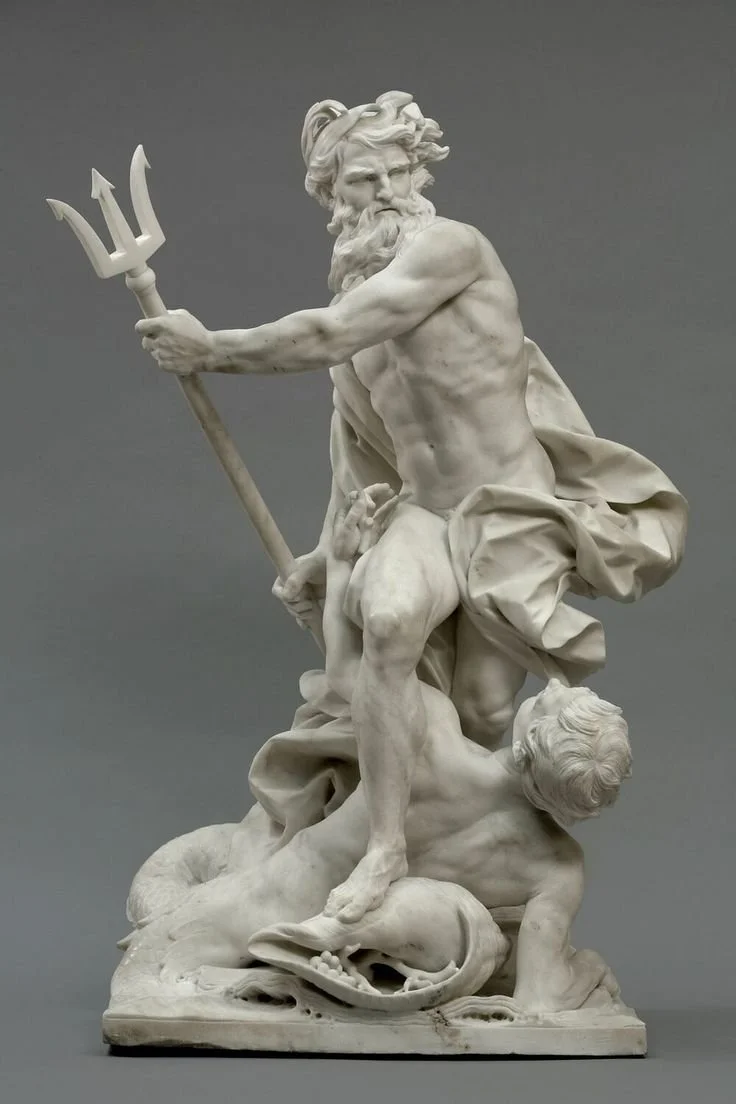
* Images sourced via Pinterest. All rights belong to the original creators.*Sculpture: Neptune Calming the Waves (Neptune calmant les flots irrités), Lambert-Sigisbert Adam, 1737. Marble. Musée du Louvre, Paris.